8.3. Example: AIP (C37H59O8N8S+)
Tip
The sample input and output files can be found in testfiles/geom/10-aip-xTB.
AIP is short for “autoinducing peptide” that plays an important role in quorum sensing. Its structure is given in Flexibility and let’s try to find its most stable conformation. The input file is:
lm_dir          aip      # Save the local minima to this folder.
num_calcs       1000     # Total number of calculations.
do_coarse_opt   yes      # no: Do NOT do the coarse optimization.
min_energy_gap  5.E-4    # When two energies differ smaller than
                         # this value, they are treated as identical.
                         # A negative number means do not remove
                         # energetically degenerate ones.
max_geom_iters  3000     # The maximum number of iterations for local optimization.
                         # If it is less than or equal to zero, then the number is unlimited.

components
  aip.xyz 1
  fix 0 0 0 0 0 0
  nH nH
  38 40 46 48 52 58 60 62 68 74 80 89 99 50 45 42
  ****
end

xtb
  +1 0 2
end

commands
  $xtb$
end
We fix the molecule in space, use nH nH to make all bonds between non-hydrogen atoms rotatable, and assign a deformable ring 38 40 46 48 52 58 60 62 68 74 80 89 99 50 45 42. We use xTB to do local optimization (Note that this molecule is +1 charged). Now run the conformation search:
$ geom aip.inp > aip.out
This is really a complicated molecule. In aip.out, you can find 25 rotatable bonds, and a 16-membered ring, thus manual adjustment to obtain stable conformation is very difficult.
1 aip.xyz                             1    113
Put center at (0.000,0.000,0.000) and rotate (0.000,0.000,0.000).
Flexible degrees of freedom:
 (  1) Bond  N(1)-C(5)
 (  2) Bond  C(5)-C(9)
 (  3) Bond  C(5)-C(7)
 (  4) Bond  C(7)-N(18)
 (  5) Bond  C(9)-C(14)
 (  6) Bond  C(9)-C(11)
 (  7) Bond  C(11)-C(20)
 (  8) Bond  N(18)-C(24)
 (  9) Bond  C(24)-C(26)
 ( 10) Bond  C(24)-C(28)
 ( 11) Bond  C(26)-N(33)
 ( 12) Bond  C(28)-C(31)
 ( 13) Bond  C(31)-N(35)
 ( 14) Bond  N(33)-C(38)
 ( 15) Bond  C(48)-C(54)
 ( 16) Bond  C(60)-C(64)
 ( 17) Bond  C(64)-C(67)
 ( 18) Bond  C(74)-C(82)
 ( 19) Bond  C(82)-C(87)
 ( 20) Bond  C(87)-C(91)
 ( 21) Bond  C(87)-C(95)
 ( 22) Bond  C(99)-C(101)
 ( 23) Bond  C(101)-C(104)
 ( 24) Bond  C(104)-C(110)
 ( 25) Bond  C(104)-C(106)
 ( 26) Cycle C(38)-C(40)-N(46)-C(48)-C(52)-N(58)-C(60)-C(62)-N(68)-C(74)-C(80)-N(89)-C(99)-C(50)-S(45)-C(42)
After the optimization, the end of aip.out is
 -- Result Report --
Results are energy-increasingly reordered.
Structures of energies within 1.000E-04 are treated as degenerate.
All minima are saved to "aip".
-------------------------------------------------------------------
     #  index               Energy            NaiveRMSD
-------------------------------------------------------------------
     0    345        -168.29613684           0.00000000
     1    794        -168.29152685           4.49476342
     2    853        -168.28840664           3.54429000
     3    617        -168.28581256           4.97811510
     4    330        -168.28504448           5.05308316
     5    764        -168.28362664           4.76074589
     6    541        -168.28304446           4.93962633
     7    294        -168.28246556           4.48029849
     8    728        -168.28165401           5.53526394
     9    744        -168.28109461           4.93295742
The most stable isomer is aip/345.xyz, which is shown below:
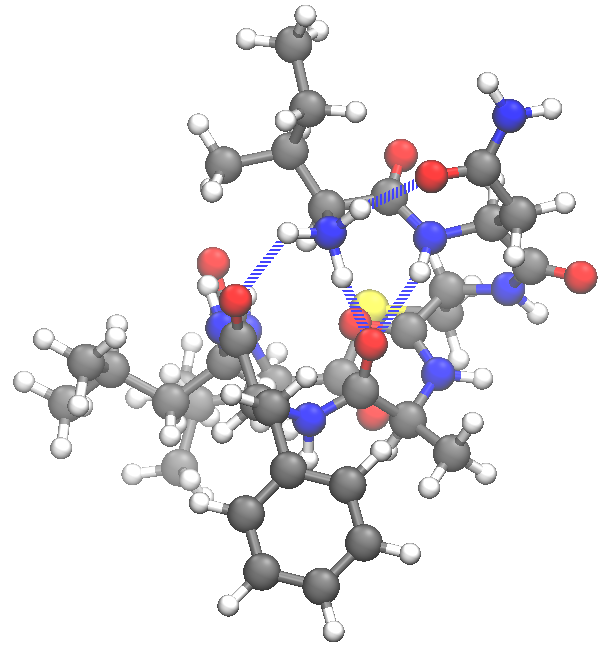
You can see that, the ring deforms and side chains rotate to form several hydrogen bonds.
Tip
Of course, the accuracy of xTB is insufficient for detailed structure predictions. So, in practical research please use a suitable DFT method to refine, say, top 10 structures to obtain the true global minimum.